
For Courts & Probation
Nationwide Court-Ordered Monitoring with Structured Compliance Reporting
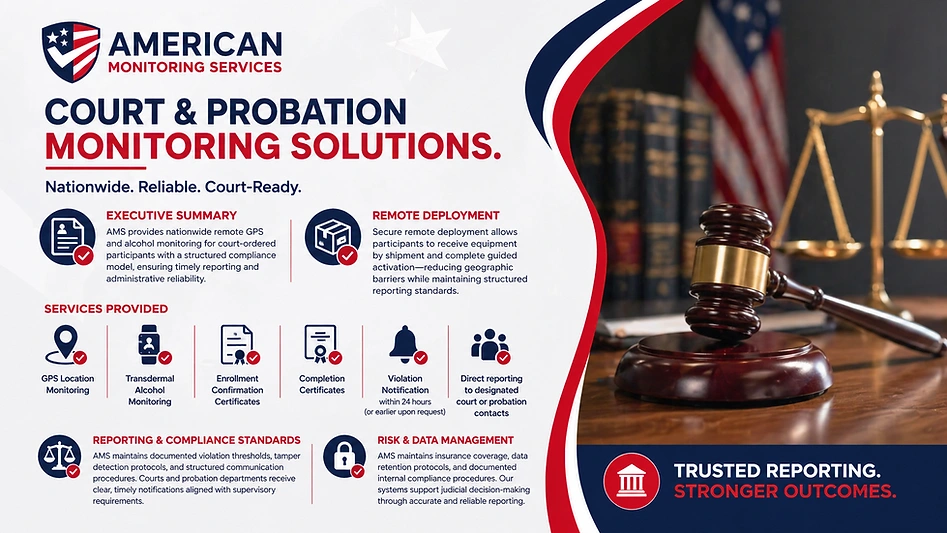
American Monitoring Services (AMS) provides remote GPS and alcohol monitoring services designed to expand access to supervision while maintaining structured reporting standards and timely communication with courts and probation departments.
Our services are available nationwide and are structured to support jurisdictions seeking reliable monitoring options without increasing administrative burden.
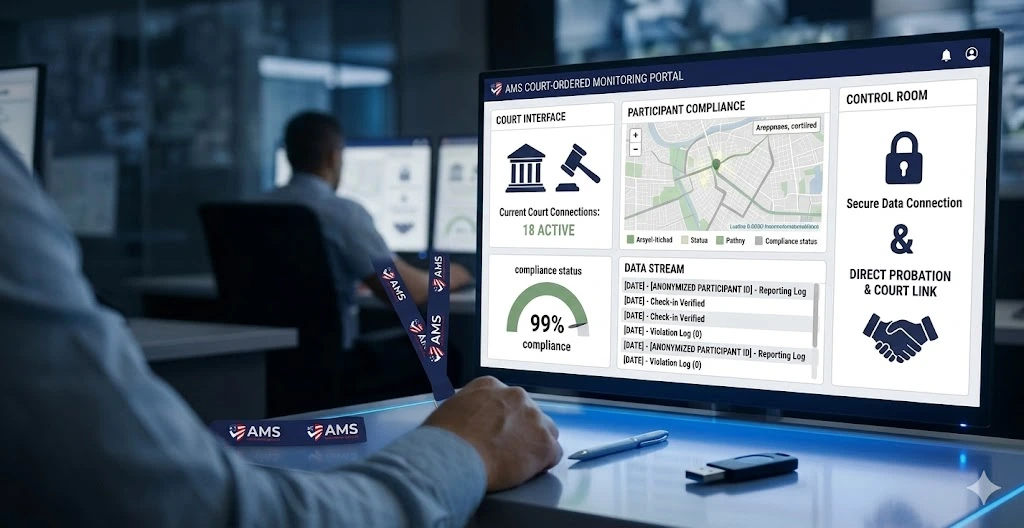
Our Role
AMS serves as a monitoring provider for court-ordered participants under pretrial, diversion, probation, or other supervisory conditions. We work directly with designated court or probation contacts to ensure enrollment documentation, reporting protocols, and violation notifications are delivered promptly and professionally.
We understand that monitoring providers must operate with accuracy, transparency, and consistency. Our internal procedures are designed with those priorities in mind.
Services Provided
GPS Location Monitoring
Real-time location tracking Inclusion and exclusion zone monitoring Tamper detection alerts Structured violation reporting
Alcohol Monitoring
Transdermal alcohol detection Continuous or scheduled monitoring options Documented violation thresholds Timely notification protocols

Reporting & Documentation
AMS provides:
- Enrollment confirmation certificates
- Completion certificates
- Violation notifications within 24 hours (or sooner if requested)
- Payment required for 15 days in advance for GPS, 15 day minimum. 25 days required for Alcohol monitoring.
- Direct email communication to designated court or probation personnel
All reporting is structured to support judicial and supervisory decision-making.

Remote Deployment Model
AMS utilizes a secure remote deployment process that allows participants to receive monitoring equipment by shipment and complete guided activation without requiring in-person installation.
This model is designed to:
- Expand access in rural or underserved jurisdictions
- Reduce missed installation appointments
- Eliminate the need for local equipment inventory
- Maintain consistent reporting standards
Remote activation does not alter reporting procedures or compliance thresholds.

Administrative Considerations
Our services are structured to:
- Avoid increasing court administrative workload
- Provide clear points of contact
- Maintain documented violation criteria
- Support jurisdiction-specific reporting preferences
We recognize that each jurisdiction operates under its own policies and procedures. AMS works cooperatively with designated contacts to ensure alignment with local requirements.
Data Integrity & Risk Management
AMS maintains:
- Documented violation response procedures
- Tamper alert monitoring
- Data retention protocols
- Insurance coverage
We understand the importance of reliability and professional communication in court-ordered supervision matters.
Informational Demonstrations
Courts, probation departments, and pretrial services agencies may request an informational demonstration of our enrollment workflow, reporting structure, and notification protocols.
To request additional information or schedule a demonstration, please contact:
Elizabeth Sweet
Director of Court Relations
- 866-896-8280 (ext. 5)
- elizabeth@amsehm.com
Frequently Asked Questions
Welcome to the future of community supervision. At American Monitoring Services (AMS), we are positive disruptors in the electronic monitoring (EM) industry. By leveraging remote deployment, we bridge the geographic divide, ensuring that participants in rural or underserved areas have equal access to liberty-granting technology through affordable, flat-rate solutions
Service & Process
Our remote deployment model is designed for speed and convenience, following these five steps:
- Direct Shipment: We ship the monitoring device directly to the participant, eliminating the need for travel to a physical office
- Guided Remote Enrollment: Upon receipt, our staff supervises the wearer through a guided enrollment procedure remotely
- Secure Remote Connection: The device is connected to our system via secure 4G/5G cellular or Bluetooth technology
- System Verification: We verify core requirements, including Global Navigation Satellite System (GNSS) polling and tamper detection
- Structured Reporting: Once active, the system begins delivering logs to authorized judicial entities immediately
Yes. AMS provides structured, secure reporting for the entire legal spectrum. We deliver data to pretrial services agencies to assist those awaiting trial, and to probation departments and courts to enforce community supervision requirements following a conviction
Technology & Infrastructure
AMS utilizes a variety of state-of-the-art hardware and virtual solutions tailored to different risk levels:
GPS Monitors: Continuous tracking using GPS watch-style device, which features cell tower triangulation to maintain reporting in varied environments
GUYS: Do we disclose the manufacturer or not?
Yes. Our GNSS devices calculate location via one-way satellite signals, which are generally available even when cellular service is absent. While a cellular handshake is required to transmit data, our devices are designed for rapid recovery; they store data packets and send them as soon as a sufficient signal is reached. For the initial activation, the participant simply needs to be in a location with enough service to facilitate the secure remote handshake.
Security & Compliance
We protect sensitive location data through:
Verifying Every Connection: Our guided remote enrollment uses a verified and encrypted handshake between the device and our monitoring center.
Modern Network Infrastructure: By utilizing 4G and 5G networks, we provide a more robust and “data-secure connection” than older, obsolete systems.
Authorized Reporting Only: Data is delivered through formal, secure channels only to the specific courts or probation officers responsible for a participant’s case.
GUYS: WE NEED TO ENCRYPT OUR EMAILS
Our devices are protected by integrated physical and digital measures:
Physical measures: Hardware includes tamper-resistant strap sensors and reinforced bands that trigger immediate alarms if cut or dismantled
Digital measures: We use system integrity monitoring to detect efforts to remove SIM cards or dismantle hardware.
Real-time Alerts: Modern network connectivity ensures that hardware issues or tamper events are communicated to our monitoring center instantly
Support & Reliability
AMS operates a fully remote, centralized support model . By eliminating expensive “brick-and-mortar” storefronts, we can provide immediate technical assistance and manage our device fleet more efficiently. This proactive approach allows us to offer participants low, flat daily rates while ensuring their hardware is continuously monitored for malfunctions
Remote deployment removes the “transportation barrier” that often leads to technical violations. Participants no longer have to take an entire day off work or find transportation to a courthouse hours away [381, Conversation History]. By allowing for virtual check-ins and automated appointment reminders, we increase reporting rates to 85–90%, helping rural participants maintain employment and stay on the path of stability
Court Relations
Meet The Team
Elizabeth S
Elizabeth Sweet is the Director of Court Relations for American Monitoring Services. A licensed attorney since 1994, she is a member of the Washington State Bar and the Federal Bar. Ms. Sweet brings more than 25 years of experience as a trial attorney, including over 15 years in criminal law as both a prosecutor and defense counsel. She also served for more than six years as defense counsel for the Washington State Department of Corrections, representing offenders in probation violation matters at risk for reincarceration. A former Captain in the United States Army Judge Advocate General’s Corps (JAGC), Ms. Sweet has extensive courtroom, compliance, and supervision-related experience. She is additionally trained as a mediator and as a Judge pro tempore. Her professional background provides a comprehensive understanding of pretrial systems, supervision practices, and the legal and operational considerations impacting courts and probation agencies nationwide.

Court Relations
Nationwide Monitoring Capability
Ability to supervise participants across jurisdictions, including out-of-county and out-of-state placements.
Rapid Enrollment (24–48 Hours)
Structured intake process designed to meet court timelines and minimize delays in compliance.
Court-Ready Documentation
Immediate provision of enrollment confirmations, monitoring summaries, and completion certificates suitable for court submission.
24/7 Monitoring & Response Framework
Continuous monitoring with real-time data collection and prompt review of alerts and events.
Timely Violation Reporting
Verified violations reported within 24 hours (or sooner upon request) to designated court, probation, or pretrial contacts.
Direct Communication with Supervising Authorities
Dedicated Court Relations contact for judges, court staff, probation, and pretrial services.
Structured Supervision Parameters
Supports home detention, curfew enforcement, exclusion zones, and victim safety geofencing.
Tamper Detection & Device Integrity Controls
Secure attachment systems with automated alerts for attempted removal or interference.
Independent Cellular Connectivity
Devices operate without reliance on participant internet access, ensuring consistent monitoring.
Support for Pretrial, Probation, and Court-Ordered Conditions
Flexible use across multiple stages of the justice process.
Supplemental to Existing Court Programs
Designed to support—not replace—court and probation systems where additional capacity or flexibility is needed.
Interstate & Remote Supervision Capability
Effective monitoring for participants residing outside the jurisdiction.
Monitoring Verification Packet for Court Review
Standardized documentation available to assist courts in evaluating monitoring requests.
Professional, Neutral Reporting Standards
Objective, consistent reporting focused on compliance, not advocacy.
What does a remote deployment activation video call look like?
A remote deployment activation video call is a supervised, step-by-step procedure known as guided remote enrollment. This process replaces the traditional requirement for a participant to travel to a physical office for equipment fitting. While interfaces may vary by provider, the process typically includes the following:
1. Visual Verification of the Participant
The primary purpose of the video call is to visually confirm the wearer’s identity and ensure the correct individual is being enrolled in the monitoring system. Some modern supervision applications may also use biometric facial comparison technology for additional verification
2. Supervised Device Installation
During the call, monitoring staff guide the participant through the physical setup of the monitoring equipment.
This includes:
- Fitting the device securely to the ankle or wrist
- Verifying tamper-detection sensors are functioning properly
- Confirming the device powers on and charges correctly
- Ensuring no installation-related tamper alerts are triggered
3. Secure System Handshake
While the video call is active, the device establishes a secure connection with the monitoring center through cellular, GPS, Bluetooth, or Wi-Fi technology.
Staff verify that the system is successfully:
Polling GPS/GNSS location data
Recording the participant’s location accurately
Communicating correctly with monitoring software
4. Digital Onboarding and Instructions
The video conferencing platform allows supervisors to review monitoring requirements and supervision terms directly with the participant.
This may include:
Explaining exclusion or restricted zones
Reviewing approved schedules for work, school, or treatment
Completing questionnaires or digital forms
Providing instructions for future virtual check-ins
By utilizing remote deployment methods, monitoring services can reach participants anywhere cellular service is available, making electronic monitoring accessible regardless of geography.
Electronic Monitoring Device Standards
Electronic monitoring products and services are designed to meet the following operational and safety standards:
- Operate in active, passive, and hybrid modes.
- Be capable of being worn on the participant’s ankle.
- Be lightweight and compact.
- Be sealed and water-resistant.
- Be hypoallergenic and not pose a safety risk to participants or personnel.
- Be easily attached and removed in less than ten (10) minutes.
- Be durable and shock-resistant.
- Connect to monitoring servers through a cellular network.
- Utilize multiple cellular towers for optimal tracking performance.
- Recognize Wi-Fi availability and roaming cellular networks.
- Include a rechargeable battery compatible with standard household power and capable of maintaining a minimum 16-hour charge.
- Support communication between staff and participants through voice, text, vibration, tones, LEDs, or display notifications.
- Include a backup location system if GPS signals are unavailable.
- Accurately enforce geofenced areas and report participant locations outside designated zones.
- Maintain accurate internal time synchronization with periodic verification checks.
- Collect and store GPS location points at intervals of no less than once per minute.
The standards set by the Federal Department of Justice on electronic surveillance and/or monitoring, all Products and Services proposed under this RFP shall meet the following requirements:
- Operate in active, passive and hybrid modes.
- Be capable of being worn on the Product User’s ankle.
- Be lightweight and small.
- Be sealed and water-resistant.
- Be hypoallergenic and must not pose a safety risk or hazard to the Product User wearing the unit or to Participating Entity personnel.
- Be easily attached to and removed from the Product User by Participating Entity personnel in less than ten (10) minutes.
- Be durable and shock-proof.
- Connect to the proposer’s server(s) through a cellular network.
- Be configurable to utilize multiple cellular towers within the Participating Entity for optimum Product User location tracking.
- Recognize wi-fi availability and roaming on cellular networks other than that of the primary cellular service provider.
- Be supplied with a rechargeable battery that operates on standard 110-volt household current and can maintain a charge for a minimum of 16 hours.
- Be supplied with the functionality for Participating Entity personnel to communicate with the Product User through the Product and/or Service which may include but may not be limited to; by voice, text, tone, vibration, light emitting diode, liquid crystal display.)
- Be supplied with a backup location system in the event a GPS signal is not present.
- Accurately restrict a Product User to the geofenced area(s) established by the Participating Entity which may include but not be limited to a range of 35 to 150 linear feet of the Product User’s home and/or residence and be able to report the location of a Product User outside any structure and/or building.
- Accurately track time on an internal clock that is automatically set with periodic time checking to verify accuracy.
- Collect and store GPS location points at a frequency not less than once every minute